
“Abolish Marriage!”

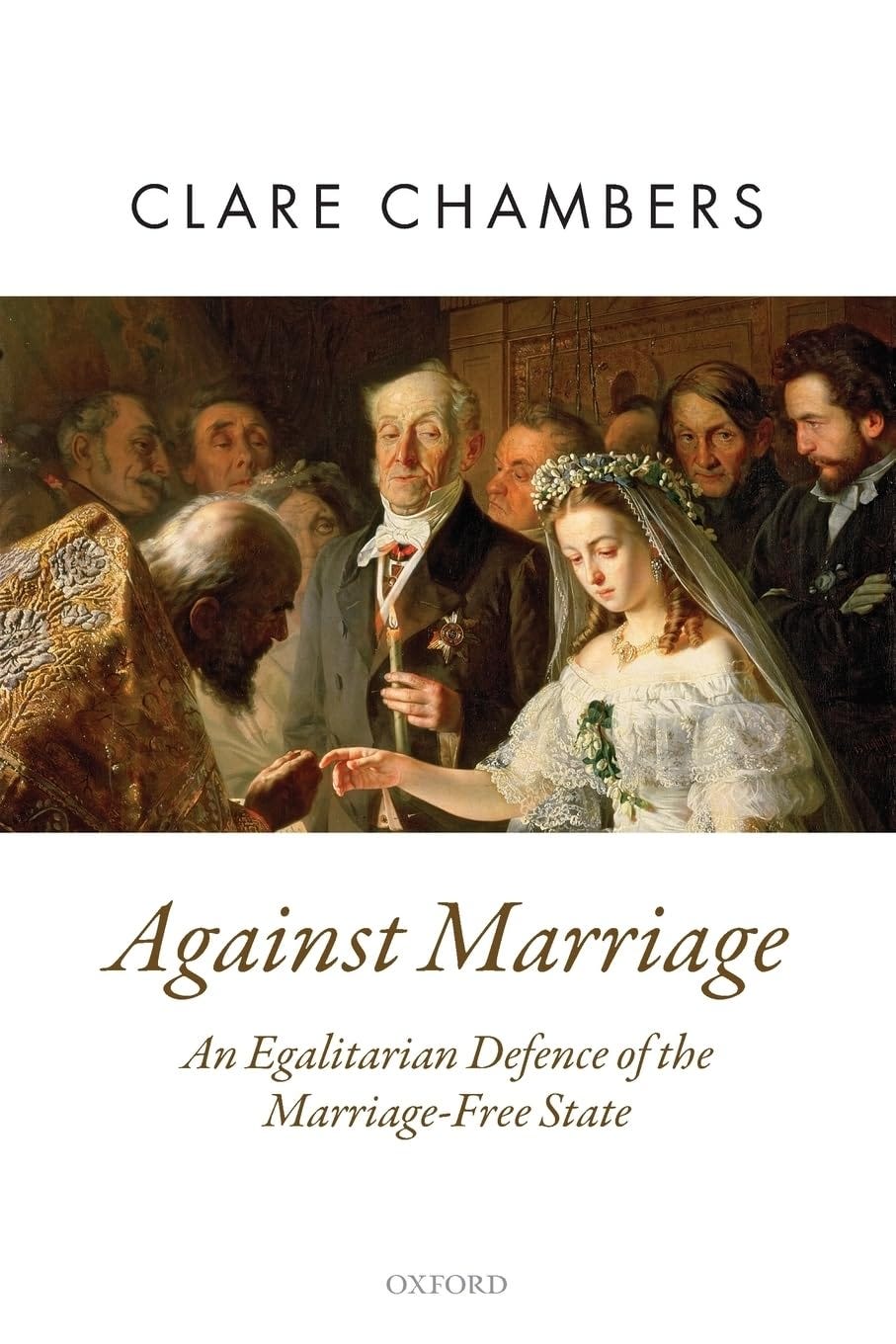
1. Should the state get out of the marriage business? Would it be better, if “personal relationships are regulated, the vulnerable are protected, and justice is furthered, all without the state recognition of marriage or any similar alternative”? Clare Chambers says yes, in Against Marriage: An Egalitarian Defence of the Marriage-Free State.
It’s a weird thesis. Make sure you understand it. In Chambers’ utopia, people would still get married. They’d still be introduced as husband, or wife; still throw extravagant weddings, fight over guest lists, and grit their teeth through embarrassing speeches. Chambers does not say that no one should get married, or that marriage as a social institution should cease to exist. Marriage, she says, should be like friendship: a relationship you may enter, without obtaining a license from the government.
2. Chambers’s case starts with the history. Time was, not so very long ago, that
wives legally ceded all their property, as well as custody and control of their children, to the husbands, were under a legal duty to obey their husbands, were unable to vote or divorce, and could legally be raped by their husbands.
Marriage law used to oppress women: this cannot be denied, and must be acknowledged.1 Even more lamentable is how long it took, for these injustices to be remedied; especially the law about marital rape. But these injustices have been remedied. Wives no longer legally cede all their property, etc.; so these things are no longer objections to state recognition of marriage.
What’s more, these injustices would be no objection, even if they were still in place. The remedy would be the one that was actually carried out: change the laws around marriage.
3. Chambers rightly places more weight on the injustices that marriage still causes, even now that legal equality has been achieved. Among her allegations are: “marriage tends to reinforce the gendered division of labor”; it “reinforces the idea that women do most of the housework” (she means heterosexual marriage—same sex marriage was legal when her book was published); and it may exacerbate domestic violence. These are serious charges. But to evaluate them, one needs to evaluate evidence that marriage is a cause, and not just a correlate, of these things. Chambers cites some studies to that effect. But so much social science has been cast into doubt by the replication crisis, that one should withhold judgment about all of it, unless one has the right statistical expertise, and has carefully scrutinized a large number of studies and meta-analyses; which I do not have and have not done. What’s more, as Chambers herself says later in the book, no current social science could support conclusions about the effects, not of marriage—remember, she’s not against marriage!—but of state recognition of marriage. There’s no “control group” of married people living in a state which does not recognize marriage, to compare to ours, and see whether it’s state recognition itself that discourages husbands from bringing their dishes all the way to the sink.
You might reply that, if the social institution of marriage “tends to reinforce the gendered division of labor,” and if this is unjust, then that alone is an objection to state recognition of marriage. States shouldn’t endorse unjust social practices. But if our concern is with justice, removing state recognition is not much of a remedy, for the injustice will persist. Better to change social attitudes, so that getting married no longer tends to reinforce various bad behaviors. That’s hard, for sure, maybe ridiculously impractical. But so is abolishing state recognition of marriage.
4. Aside from possible “material” effects on women, Chambers claims that marriage “disadvantages women symbolically.” It does this by “casting women as inferior.” Chambers has in mind a kind of psychic harm: “through social pressures, an individual feels herself to be inferior or worthless.” How does marriage do that? She writes,
marriage enacts on women in contemporary western societies...the sense that they are flawed and failing if unmarried.
To argue that marriage materially harms women, Chambers presented evidence from social science. Here, for the psychic harms, her evidence is anecdotal. She mentions self-help books and romantic comedies. My equally unscientific take is that popular culture contains just as much if not more content valorizing independence and castigating marriage as boring, limiting, or square. Nor is any attempt made to show that culture causes women to feel flawed if unmarried—it could be the other way, culture reflecting attitudes many women would have anyway. Finally, even if correct, how would these claims support Chambers’ conclusion? Again, she does not want to abolish marriage, just state recognition of marriage. Surely neither rom-com plots nor their effects on viewers would change much if all marriages became de facto.
5. The argument so far has been that marriage oppresses women. Chambers also argues that state recognition of marriage is illiberal. Liberalism (one kind) requires government neutrality: the state should not endorse one rather than another view about “what makes life valuable” (provided both are “reasonable”); the state should not benefit those who live according to one set of values, and penalize those who don’t (provided both sets are reasonable).
The ideal of neutrality emerged from the Reformation. Catholic Kings burned Protestants, then Protestant Kinds burned Catholics, until finally someone said, maybe the government shouldn’t take sides. Should it be like that for marriage? You think the good life includes marriage; I prefer polyamory, or a yearly rotation of amorous partners. Why should the state give your lifestyle legal status and legal benefits, and deny them to mine?
This argument from neutrality is better than the argument from oppression. To think it through, we must know what liberal neutrality requires. Help is welcome from those better versed in political philosophy than I. Cigarette taxes, I presume, are illiberal. It’s not unreasonable to prefer a shorter, nicotine-fueled life to a longer life of bland abstention; but the taxes are a state attempt to dissuade you from that preference. So if you’re okay with cigarette taxes, you should not be moved by liberal objections to marriage licenses.