
The Leftovers

American Independence in Verse is available for pre-order now.
The Loyalists were American colonists who rejected independence. Their story is a tragedy, but in that story they are not heroes.
Using the single term loyalist for all the opponents of independence suggests a movement. In the lead-up to 1776, one is led to think, there were two teams, the rebels and the loyalists, each vying for the allegiance of those caught in the middle. It was not so. Those we now call loyalists hardly knew there was another team, until it was too late. If the crisis that led to independence began with the Stamp Act riots in 1765, no one then, not even the most radical agitator, spoke of independence; it would be years before anyone even entertained the idea. Until then, those who would eventually sign the Declaration of Independence, and those who would refuse, largely agreed: Britain was over-reaching, in its new taxes, and then in its military actions in the colonies; and resistance to these acts was necessary. What disagreement there was, was over means, not ends: and the end was reconciliation. The loyalists only became “loyalists” when independence become a live possibility and then a living reality. In fact it is misleading to say the loyalists “became” anything. Everyone else turned to the cause of severing ties with the mother country; everyone else became American. The loyalists were those who did nothing. They stood where they had always stood, as British citizens living in the colonies. It’s like sleeping in, to find everyone caught the flight without you. You’re the same, where you’ve always been, if now in an abandoned house.
A century and a half earlier, the Puritans in England became aliens in their own land, because they joined or were born into a religious movement at odds with the larger culture. The Puritans’ alienation and persecution were so intolerable that they fled, eventually to America. The Loyalists are a sad mirror of this process. They found themselves without a home in the colonies, only because that home had been swept out from under them. The rest of America shifted its allegiance, and the loyalists were left alienated and persecuted merely for exhibiting (as they saw it) a virtue—loyalty—and for refusing to risk treason for a freedom that would, they thought, at best be a freedom from the protection of the world’s greatest empire, against looming aggressors who now would surely invade and conquer America for themselves.
As loyalist was defined in a negative—the not joining of a cause—it was hard for the loyalists to organize for collective action. So while many loyalists wrote pamphlets, as everyone then wrote pamphlets, opposing independence—Samuel Seabury of Hamilton fame, for example, and Joseph Galloway (whose attack on Congress is in American Independence in Verse: “These men, who have assumed the robes / Of guardians, will plunge you to your death”)—the loyalists didn’t really do anything, while the rebels did plenty, creating extralegal quasi-governmental institutions, including of course Congress, and then fielding armies.
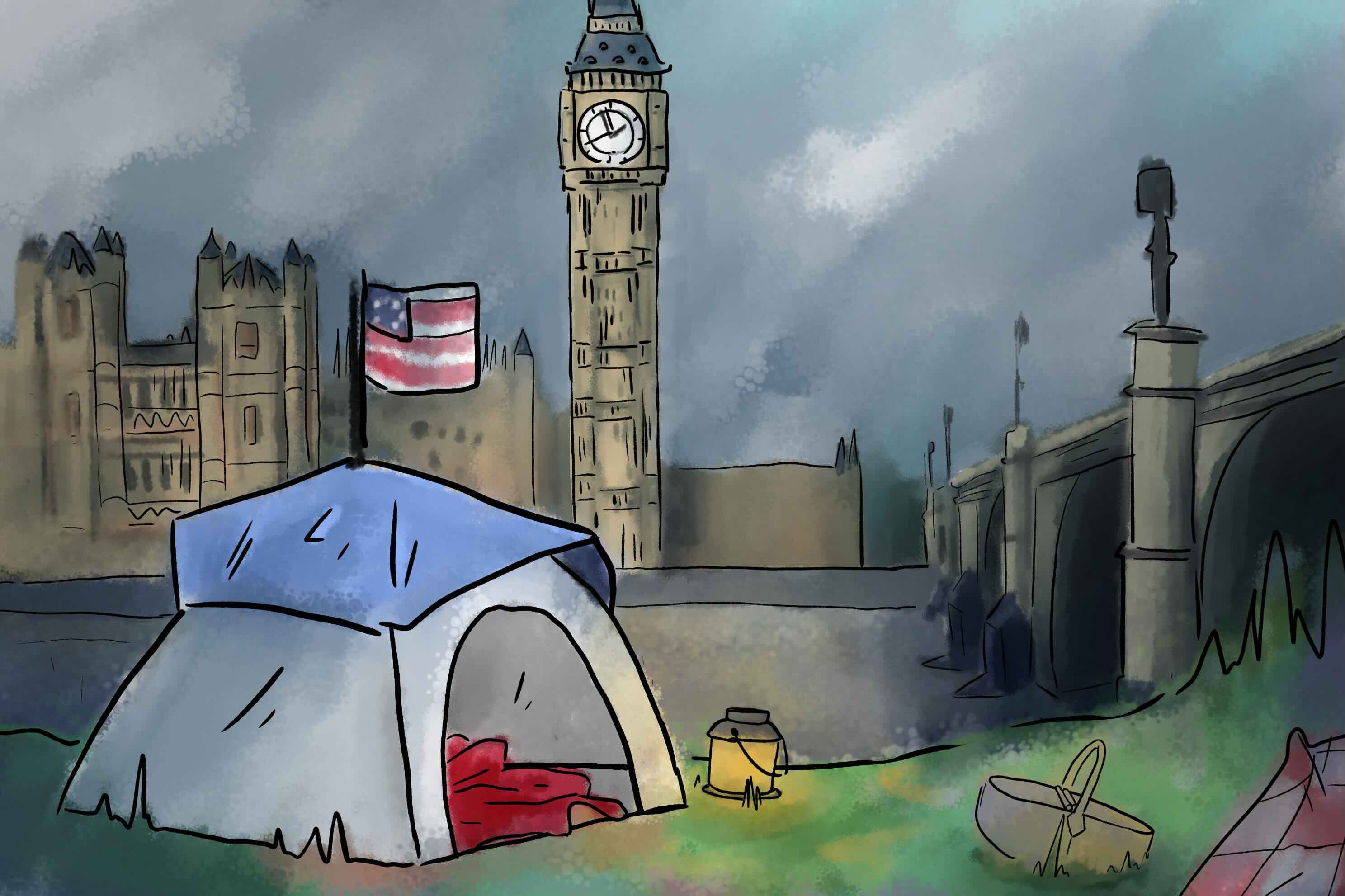
One thing the loyalists could do, was reverse the Puritan’s course, and flee a now inhospitable America, for safety in England. They were, after all, English, subjects of King George III, and if they’d never set foot on the island of Great Britain, it was still, in their conception, their home. “The Sufferings and Persecutions I have undergone,” wrote one,
together with the Rebellious Spirit of the People has weaned my Affections from my native Country—the further I go from it the better.
The tragedy of the loyalists is that, in reality, England was not home. Once there, they thought they would be welcomed as experts on the American situation, whom the ministry would consult, deferentially, for their local knowledge, and advice on how to win the war. That did not happen. The loyalists also thought their loyalty would be rewarded, with government positions, or else compensation for their sacrifices. And the British government did give money to these “American sufferers,” but it did not give much, and not for long. What was given, was given grudgingly: one member of Parliament said the stipends to the exiles were being used to feed a set of vipers, who were gnawing the very entrails of Great Britain, and spilling her best blood. When Parliament reduced the stipends after war’s end, it stung, for
the refugees assumed that any reduction meant that their devotion to Great Britain was being questioned.
This is a level of pride and entitlement I find difficult to imagine. But maybe you had to be there. Try to have some sympathy: these people had given up everything, and for what? Was it worth it? It must have been worth it; their mental lives became oriented around the conviction that it was worth it. In The British-Americans Mary Beth Norton surveys the loyalists’ evolving attitudes toward the war and independence, and it is a long and careful study of the power of confirmation bias, and of wishful thinking. The loyalists were convinced, beyond reason, that most Americas opposed independence, and had just been duped or cowed by a small number of “determined agitators” and “demagogues.” From this the loyalists inferred that, whatever real grievances the colonies had toward Britain, the revolution, since not supported by a majority, was illegitimate, and that a British victory would be just. When the British government did start listening to loyalist advice about the war, after 1778, it was this that they heard (it helped that they wanted to hear it). By stoking an unjustified optimism that a few victories would turn a large share of the colonists to the British side, the loyalists ironically contributed to Britain’s eventual defeat.
As the prospects for a British victory declined, and the loyalists began to realize that their exile may be permanent, some became homesick:
I earnestly wish to spend the remainder of my Days in America, I love the Country, I love the people.
But for most return was impossible, as many states barred these traitors from even getting off the boat. Summarizing, Norton writes that all the various loyalists who had gone to Britain faced, in that new place,
the same problem of acclimation...they found a culture and even a system of government alien to their experience. Although they had left their property and sometimes their families because of their adherence to the crown, they soon learned that their sacrifices were not appreciated in the mother country. The adjustment to the hard realities of exile was long, painful, and not entirely successful...the loyalists realized how American they were only after they had abandoned America.
But I disagree with Norton’s assessment.
(Below the fold, for premium subscribers: the loyalists as a separate people; disunity among the loyalists contrasted with American cohesion; the potential and real homelands of New Ireland and New Brunswick; and their “futile hopes for reunification.”)